
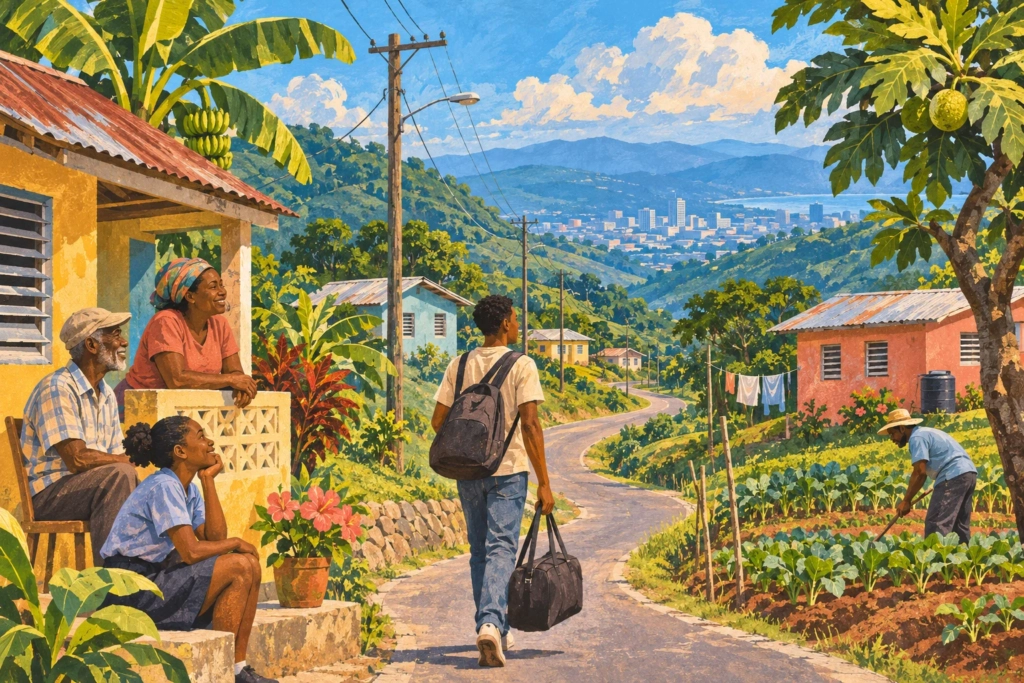
Why Rural Jamaicans Are Leaving Their Communities in Search of Better Opportunities
The full article
Before I was born, my family lived in a rural community in Jamaica where they farm for a living. However, as they got older, their kids branched out to find opportunities in areas like Kingston, Montego Bay, Ochi Rios and Negril. Unfortunately, a job can be close enough to mark on a map and too far away to keep because cost of living immediately became a problem.
If the first bus cannot get you to work on time, or the last one leaves before your shift ends, it will be spent on taxis and that starts to become more costly over time. The wage offer has always been far less that what anyone could live on back then. Even now that situation has not improved.
Even if individuals opt to change careers for better pay and opportunity, they have to consider the cost for the training course and transportation that takes two fares each way. If medical situations occur a clinic visit takes all day and will costs more than a day’s pay. Now with everything combine, moving closer can start to look cheaper than staying in rural areas. But is it really?
It can sure help to explain why some Jamaicans opt to leave rural communities in search of better opportunities. But are those opportunities worth the sacrifices one must make in order to survive in areas that demands upfront cost for everything?
People does cut cost by moving in with family and friends to go to school, or try something new. The move in their perspective was both an ambition and a response to limited options. The question worth asking is not why someone would leave a place they love, but what it takes to build the life they want while staying there.
Distance can turn a service into a luxury
A school, clinic or job opening is useful only if you can reach it regularly. A student who has to change transport twice may decline an evening course that a classmate can attend without a second thought. Someone who takes a relative to a medical appointment may have to arrange cover at work and childcare as well as the fare. None of those costs appears in the price of the service itself.
Water makes the difference between a service being available and being dependable especially clear. Jamaica’s National Water Resources Master Plan describes water shops and community catchment tanks in areas outside regular utility service. These are practical ways to get water to communities. But collecting water and planning around supply still take time that a household with a dependable tap can spend elsewhere. Access varies, so it would be wrong to describe all rural households as facing the same problem.
Making a living is not the same as finding a job
Rural Jamaica is not short of enterprise. Farmers, tradespeople, shopkeepers and tourism workers make a living in communities that are often described only in terms of what they lack. The harder question is whether earnings can carry a household through a slow season, a lost customer or a bad harvest. A farmer can have produce ready for sale and still lose money if getting it to a buyer costs too much or takes too long.
In May 2026, the Ministry of Agriculture, Fisheries and Mining said it was targeting 60 farm roads for rehabilitation that year. That was a target, not a count of completed repairs. The practical test for farmers is whether a repaired road stays usable after heavy rain and makes it easier to deliver produce before it spoils.
A 2024 Jamaica Climate Change Youth Council policy brief, supported by the International Organization for Migration, identifies employment, education and environmental pressures as factors in internal migration. Those pressures can overlap. A household already weighing a move for work might reconsider after a drought cuts farm income. The brief helps explain how these decisions can come about; it does not tell us how many people moved for any one reason.
What the numbers tell us, and what they don’t
The Planning Institute of Jamaica’s 2024 poverty estimates put poverty at 11.0 per cent in rural areas, 9.4 per cent in other urban centres and 2.5 per cent in the Greater Kingston Metropolitan Area. The national estimate was 7.8 per cent, statistically similar to 8.2 per cent in 2023. The measure is based on household consumption, not income. The regional differences matter, but they do not mean moving to Kingston will make a household better off.
It is also easy to read too much about migration into a census table. In its 2022 census tables, STATIN classifies 61 per cent of enumeration districts as urban. Enumeration districts are areas used to organize the census; that figure counts districts, not the people living in them or the number who moved. Even a count of urban residents would not tell us why they live there.
Moving can solve one problem and introduce another
Being closer to a wider range of employers, schools and services can make a move worthwhile. So can living near a relative who can help with childcare or share rent. But a higher wage does not necessarily leave more money at the end of the month. Rent, commuting and childcare can swallow the difference. A move that makes it easier to reach a hospital can put a household farther from the relatives it relied on back home.
Nor is every move a journey from a rural district straight to Kingston. A parish capital may offer a course, a clinic or a steadier job without taking someone as far from home. That matters for policy: a reliable connection to the nearest town may change a household’s options more than a project designed around the idea that opportunity is available only in the capital.
What would make staying a real choice?
Start with the journeys people have to make every week. Does the first bus reach town before work begins? Can a farmer get to market when it rains? Is a clinic open at hours people can use without losing a shift? Those are better tests of an investment than the number of projects announced. They also show where services need to work together: a training center does little for someone who cannot afford to get to it, and repairing a road will not, on its own, put a bus on it.
Some Jamaicans will leave even if things improve at home. That is not a failure. People should be free to study, build a career or start a family somewhere else. They should also be able to stay without accepting that a routine appointment, a training course or a decent job will always take more time and money to reach. The point is not to make fewer people move. It is to give them a better choice about whether they have to.